CarMax: Used Cars for Sale
- 4.6
- Rating
- 5.00M
- Installs
- Free
- Price

 Analysis by App-foxy
Shopping for a used vehicle can quickly turn into a messy mix of dealership pages, saved browser tabs, vague photos, and repeated searches. I found CarMax: Used Cars for Sale most useful when I wanted to turn that process into one focused browsing session. It is a free Auto & Vehicles app from CarMax Enterprise Services, LLC, built around searching a large selection of used cars, SUVs, and trucks from a phone.
My overall view is positive, but with an important qualification: this is strongest as a discovery and comparison tool, not as a complete replacement for inspecting and evaluating a vehicle in person. It makes the early part of shopping easier, especially when I know roughly what type of vehicle I want. It is less satisfying for someone who expects an app alone to settle every question about condition, ownership costs, or whether a particular car is the right long-term purchase.
What the CarMax app does well during the search
The first thing I noticed is how naturally the app fits the way people actually begin a car search. I can start with a broad idea, such as looking for a compact SUV, and gradually narrow the results as my needs become clearer. Alternatively, I can begin with a specific make, body style, or budget and use the available inventory to see whether that target is realistic.
You May Also Like

 Blood Strike: 2.5 Anniversary
Blood Strike’s Loadouts Turn Every Drop Into a Tactical Gamble
A close look at Blood Strike’s custom loadouts: how fast access to signature weapons reshapes its battle royale rhythm, rewards preparation, and narrows the gap between fights.

 Pandora - Music & Podcasts
Pandora’s Music Is Easy to Start, but Harder to Recover
Pandora’s strength is its low-effort path from a seed to a station. Its weak spot is how much confidence it asks you to place in connection, setup, and quiet recovery.

 8 Ball Pool
 Is Built on Rivalries, Rematches, and Routine
A close look at the rivalries, rematches, shared routines, and unanswered safety questions that turn a quick pool match into a persistent mobile community.

 Samsung Music
’s Quiet Strength Is Playing What You Already Own
Its reach comes less from spectacle than from dependable access to a personal library. That simplicity is both the app’s strongest retention engine and its ceiling.

 AccuWeather: Weather Radar
AccuWeather Review: A Quick, Clear Forecast for Everyday Decisions
For everyday plans, the best forecast is the one you can understand quickly. AccuWeather makes rain timing, radar, and local conditions easy to act on, with a few trade-offs.

 Hill Climb Racing
Why Hill Climb Racing Still Turns Crashes Into One More Run
A tiny car, a bumpy hill and one more upgrade: Hill Climb Racing keeps resurfacing because its simple chaos makes every near-miss feel personal.
More From Our News Desk
View All News


That flexibility matters because used-car shopping rarely starts with a perfect specification sheet. I might know that I need room for passengers and luggage but not yet know which model makes sense. Browsing a broad selection helps me discover alternatives instead of locking myself into the first model I had in mind. On the other hand, if I already have a particular vehicle in mind, a focused search is more efficient than scrolling through unrelated listings.
The app’s central advantage is scale. Its store summary describes a selection of more than forty thousand used cars, SUVs, and trucks, so the experience is designed for comparison rather than a single local listing. That does not mean every vehicle will be relevant to every shopper, but it gives the search enough breadth to make filters and careful shortlisting worthwhile.
I also like that the app belongs to a recognizable vehicle retailer rather than functioning as a general classifieds board. That makes the browsing experience feel more directed. I am looking through inventory intended for a retail purchase, not trying to interpret dozens of unrelated seller styles. For a first pass, that reduction in noise is valuable.
A practical workflow for narrowing down choices
My preferred approach is to avoid entering too many requirements at the start. I begin with the essentials: vehicle type, a comfortable spending range, and the general area in which I am willing to shop. Then I look at the results and adjust one condition at a time. This reveals which requirement is making the search difficult.
For example, if I am searching for an SUV with a certain age and price range, I might first browse the available results without insisting on a specific trim. If the list is too large, I narrow by make or model. If it becomes nearly empty, I relax the least important condition rather than abandoning the search. This is a more useful workflow than treating the first search as a final answer.
A less obvious benefit of this method is that the app can expose trade-offs early. A newer vehicle may require accepting a different body style, fewer convenience features, or a greater distance from home. Seeing those compromises while browsing is more honest than assuming every preferred specification will appear together at an attractive price.
I recommend saving or recording a small shortlist outside the excitement of the moment. A vehicle that looks perfect in isolation may be less appealing when compared with three similar options. The app is most helpful when I use it to create that comparison set, not when I simply open the first attractive listing and start planning around it.
Useful for real-life shopping situations
Consider a commuter whose current car has become unreliable. They need transportation soon, but they do not want to buy the first vehicle available nearby. With the app, they can search during a lunch break, compare several body styles, and identify which options are close enough to investigate. That is a realistic advantage: the phone becomes a planning tool before the dealership visit rather than the place where every decision must be made.
It is also useful for a family whose needs have changed. Someone moving from a small sedan to an SUV can browse the broader category without visiting several websites. A buyer replacing an aging pickup can compare trucks by general configuration and availability before deciding whether the change in budget is manageable. In both cases, the app helps turn an abstract need into a shortlist.
For a remote shopper, the value is more limited but still meaningful. The app can help identify candidate vehicles and organize the questions that need answering before making a longer trip. I would not treat a polished listing as enough reason to travel several hours without confirming the details directly and arranging an inspection.
Where the experience feels more convincing than a general marketplace
Compared with a broad classified marketplace, the CarMax app feels more focused on browsing retail inventory. General marketplaces can offer excellent local variety, including private-party vehicles that may be priced differently. They can also create more work because descriptions, photos, communication habits, and seller reliability vary widely.
CarMax’s app is a better fit when I want a more structured starting point and prefer dealing with a large vehicle retailer. A general marketplace may be better when the lowest possible purchase price is the priority, when I am comfortable evaluating private sellers, or when I am searching for an unusual older vehicle that a large retailer may not carry.
There is another important comparison with manufacturer-certified inventory pages. Brand-specific sites can be better when I already know I want one manufacturer and care about that brand’s certified program. The CarMax app is more useful at the discovery stage because it lets me compare across makes and vehicle types in one retailer’s inventory. Neither approach removes the need to check the actual vehicle carefully.
What I would check before contacting a seller
I treat every promising result as a candidate, not a conclusion. Before becoming attached to a particular vehicle, I would review the listing carefully, check whether its location is practical, and write down questions about the exact configuration. A model name alone does not tell me whether the vehicle has the seating, cargo layout, drivetrain, or equipment I need.
I would also compare similar vehicles instead of judging value from one listing. The app makes that broad comparison possible, but the responsibility still sits with me. Mileage, age, trim, condition, maintenance history, and local demand can all change whether a vehicle is sensible. Two cars that look similar in a search result may be very different purchases.
My strongest tip is to separate “I like this car” from “this car fits my situation.” The first is emotional and immediate; the second requires checking insurance, fuel use, parking, passenger needs, expected maintenance, and the total budget. A browsing app can support that thinking, but it cannot perform it for me.
The limitations that affect the buying decision
The biggest weakness is that convenient browsing can create a false sense of completion. Finding a vehicle in the app is only one stage of buying used. I still need to verify the listing details, understand the vehicle’s history, inspect its condition, and consider whether the final ownership cost makes sense. Anyone expecting the app to replace those steps may come away disappointed.
Search results are also only as useful as the criteria I choose. If I search too broadly, I can spend a long time looking at attractive but unsuitable vehicles. If I filter too aggressively, I may miss a good alternative because of one preference that was not truly essential. This is not a flaw unique to this app, but the large inventory makes disciplined searching especially important.
Another limitation is that a retailer-centered inventory may not represent the entire used-car market. A private seller, an independent dealer, or a manufacturer-specific program could have a vehicle that better matches my budget or preferred model. The app is not the right single source for someone who wants to compare every possible route to ownership.
I also would not use the app as my only research source for reliability or running costs. A listing helps me find a vehicle, but it does not replace independent research into common problems, recall information, fuel consumption, tire costs, or repair prices for the exact model. Those details can materially change a seemingly attractive deal.
Who should use it, and who should look elsewhere
I think the app is a good match for first-time used-car shoppers who feel overwhelmed by the number of choices. Its retailer-focused browsing experience gives them a manageable place to begin. It is also useful for busy buyers who want to investigate inventory from home before spending time at a location.
It suits people who are open to several makes and models, because the broad selection rewards comparison. If I have a flexible idea such as “reliable family vehicle” or “practical truck for weekend work,” the app can help me see what kinds of vehicles are available and where my preferences conflict with my budget.
I would be more cautious recommending it to a highly experienced buyer who already knows the exact model, trim, and seller type they want. That person may get better results from manufacturer-certified listings, specialist marketplaces, local dealers, or private-party searches. Likewise, bargain hunters who are comfortable doing extensive mechanical checks may prefer a wider market than a single retailer’s inventory.
It is also not ideal for someone who dislikes research and wants a quick, definitive recommendation. The app can show possibilities, but it does not remove the judgment involved in choosing between age, mileage, equipment, location, and expected maintenance. Used-car shopping still rewards patience.
Accessibility, cost, and day-to-day practicality
The app is free, which makes it easy to install as a research companion even if I ultimately buy elsewhere. It is rated for Everyone, so its presentation is appropriate for general audiences, although the financial decisions involved still require adult judgment. The app has been available since December 2012, and its current version is 4.48.2, showing that this is an established product rather than a brand-new experiment.
Its average rating is 4.6 from roughly thirty-six thousand ratings, with about eight point nine thousand written reviews, and it has passed five million installs. Those figures suggest that many people find the basic experience useful, but I would not interpret popularity as proof that every search will be smooth. Inventory, location, and personal expectations can change the experience considerably.
On Android, the listed minimum operating-system requirement is version 10. That is reasonable for many current phones, but anyone using an older device should check compatibility before planning around the app. I would also keep the app updated while shopping, since a current version is the sensible choice when browsing changing vehicle inventory.
My final assessment
After using it as a vehicle-search companion, I see CarMax: Used Cars for Sale as a practical first step with a clear purpose. It brings a substantial retailer inventory to the phone, makes broad comparison easier, and helps turn vague shopping goals into a shortlist. Its best quality is not that it magically chooses a car; it is that it gives me a more organized way to discover realistic options.
The trade-off is that the app encourages browsing, while a good used-car purchase requires investigation. I still need to question the details, compare total costs, research the model, and inspect the vehicle. If I remember that boundary, the app becomes genuinely useful rather than misleadingly complete.
My recommendation is straightforward: use it if you want a free, focused way to explore used cars, SUVs, and trucks from a major retailer, especially when you are still deciding what fits your needs. Pair it with independent research and an in-person evaluation. If you want private-party bargains, a brand-specific certified program, or a complete view of every vehicle on the market, add other sources instead of relying on this one alone.
For my own shopping process, that is enough to make it worthwhile. I would open it before visiting dealerships, use it to compare several plausible vehicles, and let the shortlist guide my questions. The app is most valuable when it improves the quality of my next decision, not when it tries to make the decision for me.
FAQs for CarMax: Used Cars for Sale
01What features does the CarMax app offer for car buyers?
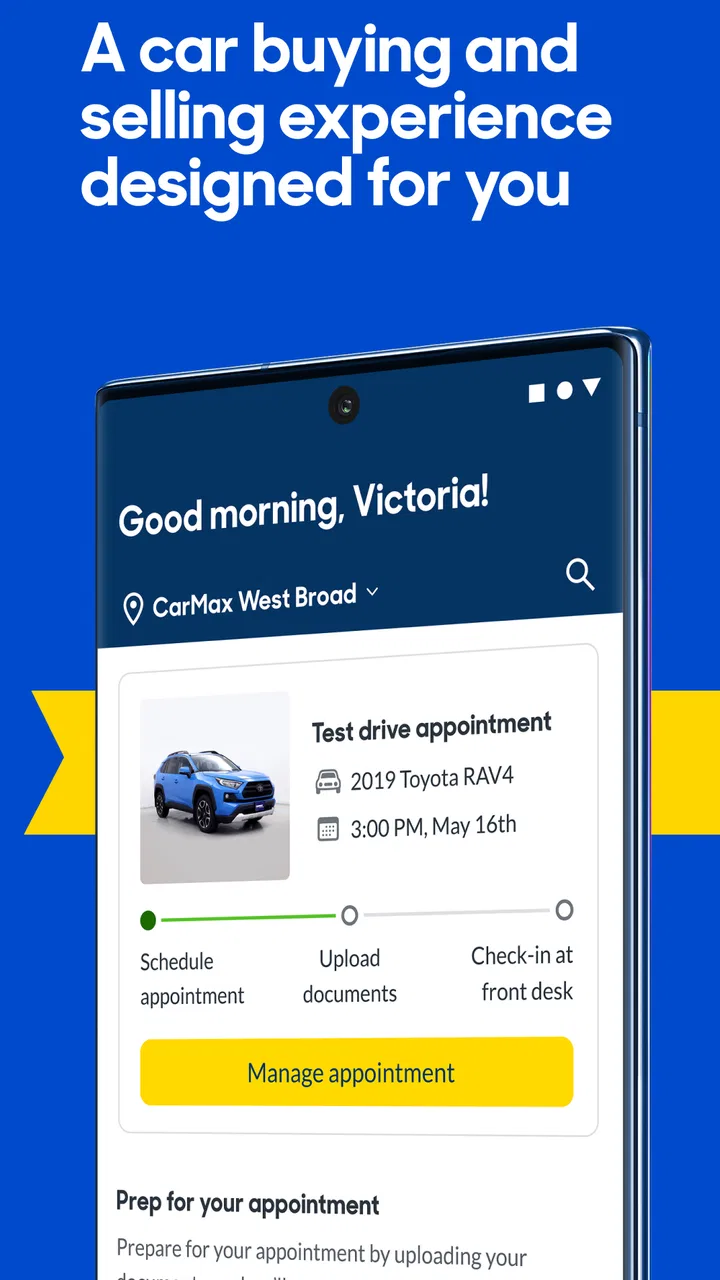
The CarMax app provides a comprehensive platform for buying used cars. It includes features such as detailed car listings with high-quality images, vehicle specifications, price comparisons, and user reviews. Additionally, it offers a financing calculator, the ability to schedule test drives, and a tool to help you trade in your old vehicle.
02How reliable are the car listings on the CarMax app?
CarMax is known for its rigorous quality checks. Each car undergoes a detailed inspection before being listed. The app reflects this commitment by providing thorough details about each vehicle's condition, history report, and pricing transparency, ensuring users can make informed purchasing decisions with confidence.
03Can I sell my car through the CarMax app?
Yes, the CarMax app allows users to sell their cars. You can receive an instant online offer by entering your vehicle's details. Afterward, you can visit a CarMax store for a final appraisal and receive payment. The process is streamlined to ensure convenience and fair market pricing.
04Is financing available through the CarMax app?
The CarMax app offers financing options for users looking to purchase a vehicle. You can pre-qualify for financing directly within the app without affecting your credit score. The app provides a range of flexible terms and competitive rates to suit different budget needs, making car ownership more accessible.
05How does the CarMax app ensure user privacy and data security?
CarMax prioritizes user privacy and data security. The app uses advanced encryption to protect sensitive information, and it complies with industry standards to ensure data protection. Users are encouraged to review the privacy policy and settings within the app to understand how their data is handled.
Pros
- Extensive car inventory available.
- User-friendly interface for easy navigation.
- Comprehensive vehicle history reports.
- Flexible financing options offered.
- Convenient in-app purchase scheduling.
Cons
- Limited availability in certain regions.
- Occasional app crashes reported.
- Delayed customer service response.
- Some features require account creation.
- Not all listings updated in real-time.

CarMax: Used Cars for Sale
Gallery